


Fojutowo
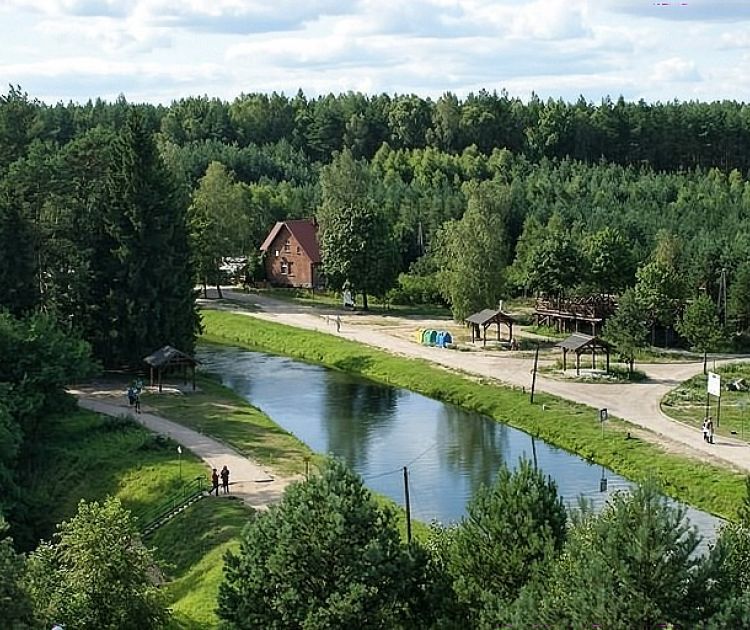
The inn is located in a small forest settlement consisting of just a few houses, situated by the Great Brda Canal, near the border of the Kuyavian-Pomeranian and Pomeranian voivodeships. The village is 3 km away from Legbąd. This place is extremely attractive not only because of its location but also due to the largest aqueduct in the country located here.
The Grand Brda Canal
A hydraulic structure – an artificial canal built by the Prussians in the 19th century to irrigate the Czersk meadows belonging to the Tuchola Forest. The canal is 21 km long and about 1 meter deep, depending on the season. Today, it serves as a kayaking route that passes under several picturesque aqueducts located above Brda's tributaries. Near Fojutowo, the canal meets the famous European-scale aqueduct, crossing the Czerska Struga stream.
Aqueduct
An irrigation system of the Great Brda Canal. The Fojutowo hydraulic structure carries the waters of the Great Brda Canal over the Czerska Struga stream. The width of the construction is 75 meters, while the difference in water levels between these two watercourses is 9 meters.

Charzykowskie Lake
This natural ribbon lake is partially located within the Tuchola Forest National Park and is considered one of the most beautiful lakes in the region. It is a wonderful place to relax, especially for those who enjoy spending their free time actively. The lake covers an area of 1,360 hectares and is an ideal spot for both sailing boats and kayaks.

Tuchola
The town is located by Lake Głęboczek, which has been developed for tourism in recent years. Here you can find a swimming area with water equipment rental, a children's play zone with a playground and a water slide, a sailing marina, and a walking path around the lake. Additionally, Tuchola is known for a high level of cultural events. One of the most popular is the annual celebration of the Tuchola Forest Days, a tradition that has lasted for 54 years. Distance from our resort: 23 km.
Raciąż with the Hillfort
An extremely important village for the history of the Tuchola district, located by a group of ribbon lakes, including Suszek, Śpierewnik, Raciąskie, Rudnica, and Przylonek. Historical records prove that this was the oldest administrative center of southern Gdańsk Pomerania. The existence of a castellany stronghold is confirmed by written sources from the second half of the 13th century. It was then located on an island in Lake Śpierewnik, 5 km from today’s village. The base of the stronghold measured 85 m by 120 m. The area was surrounded by an embankment, and on the northern side additionally by a moat and reinforcements made of wood and earth. Outside the fortifications, there was also a cemetery. Over 20 years of archaeological research of the entire interior and adjacent cemetery proved that the fortress was destroyed by fire. Remains of 5 houses, fragments of ceramic vessels, and objects made of silver, horn, glass, iron, and animal bones were discovered. A breakthrough event for regional tourism was the opening of the reconstructed stronghold on June 6th this year. Visitors can explore specially marked paths, a viewpoint, and numerous information boards detailing the history of the site and archaeological discoveries.
Distance from our resort: 20 km.
Klocek, Legbąd, Rzepiczna, Krąg
These villages are recognized as typical Borowiacy settlements due to traces of traditional folk architecture in the form of a few preserved wooden cottages. Many are still covered with thatched roofs today. Additionally, in Legbąd in June 2009, the Oak of John Paul II was planted; the sapling accompanied foresters during a pilgrimage to the Vatican in 2004.
Archaeological Reserve Kamienne Kręgi in Odry
This site is not only a nature reserve but also a fascinating archaeological area. Inside the fenced area, among rare pine forest, there are 10 complete and some fragmentary stone circles, with the smallest measuring 15 m in diameter and the largest 33 m. Around the circles are stones protruding 20 to 70 cm above the ground. Each circle contains 16 to 29 stones. One or rarely two stones are set inside the circle. In addition to the stone circles, about 30 burial mounds (kurgans) with diameters ranging from 8 to 12 m are found within the reserve.
Distance from our resort: 20 km.
Świt with Piekiełko on the Brda River
The Świt forestry area is located within the Tuchola Landscape Park, about 8 km from Tuchola. It is especially famous for the Piekiełko sanctuary, a gorge of the Brda River that, due to numerous boulders in the riverbed creating rapids and whirlpools, takes on the character of a mountain river. It is also known for a cluster of 10 oak monuments called “hanging oaks” and linden trees. The oaks are over 700 years old, with circumferences ranging around 200 cm. Additionally, a 12-km hiking trail called Uroczysko Brdy runs through here. The Niebo viewpoint allows observation of one of the most interesting river sections. Świt is also on the kayaking route and serves as a main resting and camping spot for kayakers.
Distance from our resort: 30 km.
Woziwoda Forest District
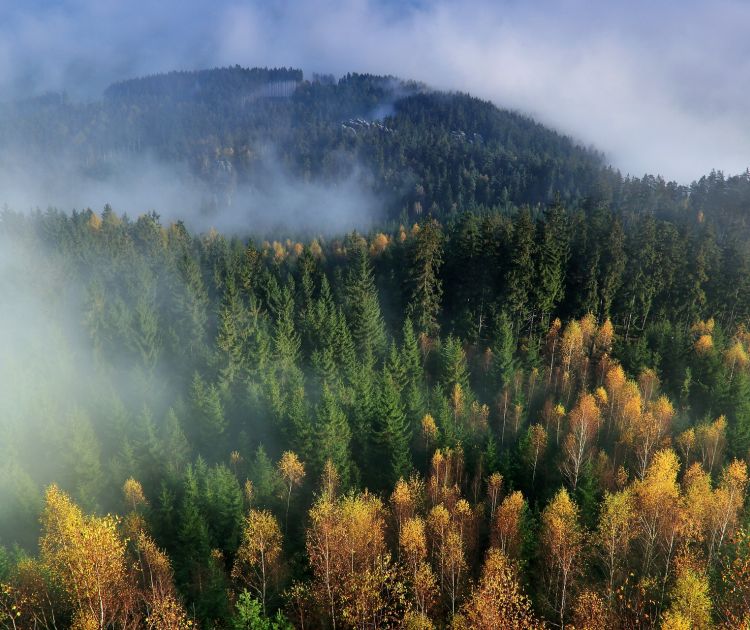
It is one of four forest districts belonging to the "Bory Tucholskie" Forest Promotional Complex. The forests managed by this district form a compact woodland rich in natural curiosities. A mosaic of lakes, a network of watercourses, numerous small forest swamps and peat bogs, varied terrain relief, and well-maintained forest compose this extraordinary natural wealth.
Distance from our Center: 10 km.
Czapli Wierch Nature Reserve
This is a faunal nature reserve named after the colony of grey herons whose nests have been located for decades in the crowns of old trees growing along the lake shores. The reserve protects the breeding sites of the grey heron and the pine forest on the shore.
Distance from our Center: 29 km.
Staropolskie Yews Nature Reserve
Located in Wierzchlas, this is one of the oldest reserves in Poland. It currently covers an area of 116.90 hectares, including a cluster of yew trees, adjacent forest, meadows, and Lake Mukrz. The reserve’s patron, artist Leon Wyczółkowski, helped popularize the Wierzchlas park through his photographs, drawings, and lithographs inspired by the "Holy Grove," as he called this place. The yews in Wierzchlas form the largest natural stand of yews in Europe.
Distance from our Center: 32 km.
Dury Nature Reserve near Tleń
A strict wetland and peat bog reserve located 4 km north of Osie near the Osie-Skórcz road. It consists of four dystrophic lakes surrounded by peatlands.
Distance from our Center: 29 km.
Rudzki Most
A district of Tuchola – Rudzki Most was established in the 1960s, located 3 km from Tuchola (Tuchola-Świecie route), on the Brda River. The river once divided the area into Rudzki Most Miejski on the right bank and Rudzki Most Królewski on the left. The presence of the Brda enhances tourism due to kayaking and camping opportunities. However, tragic historical events make this place significant. The most brutal violence occurred in autumn 1939, when Nazi occupiers executed 227 Poles in six mass shootings in the forest of Rudzki Most. The victims were buried in mass graves and later exhumed in 1946, with remains reburied in the Tuchola Mausoleum. A monument was unveiled here during Tuchola’s 700th anniversary to honor the victims, designed by artists Grażyna Litwinionek-Martul and Stanisław Lejkowski. The area also contains the Jagiełło Stone, a natural monument resembling a cone, 2.5 m long and 7.8 m in circumference.
Distance from our Center: 23 km.
Wymysłowo
A small settlement located by the Hosjanna stream, which flows into the Brda. This is a very attractive tourist spot thanks to the Sat-Okh Indian Culture Museum, one of the few in Poland and Europe devoted to the life of North American Indians. The museum’s exhibition covers not only everyday life but also spiritual life and art.
Distance from our Center: 17 km.
Dąbrówka
A village about 12 km north of Tuchola with a Baroque wooden church dedicated to St. John of Nepomuk, built in 1768. The interior retains Rococo decorations, including a pulpit, baptismal font, and main and three side altars. The main altar houses a painting by Heyn from 1884 titled "The Transfiguration of Christ." Nearby is a cemetery with the mausoleum of the Janta-Połczyński family from the mid-19th century, made entirely of masonry with a stone cross on the roof. In the village is
also a wooden manor house that belonged to the same family.
Distance from our Center: 21 km.
Śliwice
A municipal center and former princely village located by the Śliwica stream, about 30 km from Tuchola, considered an agricultural “island” amid forested areas. Śliwice and its surroundings are the only area in the Tuchola district representing the Kociewie culture. The main tourist attractions are religious monuments, including the oldest church dedicated to St. Catherine of Alexandria, built in 1830 on the site of a former church possibly dating back to the 13th century during the rule of Pomeranian princes. The current building inherited Baroque altars from the original parish, including a 17th-century two-story main altar featuring a painting of Our Lady of Sorrows, as well as two Renaissance bells. A notable local pilgrimage site is a replica of the Lourdes Grotto of the Blessed Virgin Mary near the church, built in 1908 at the initiative of Father Sychowski. From the early 20th century is also the cemetery with a small Calvary and historic tombs. Ruins of a 19th-century evangelical church and traditional Borowiak timber cottages also remain, offering potential for a local museum.
Distance from our Center: 26 km.